Tuesday, May 21, 2019

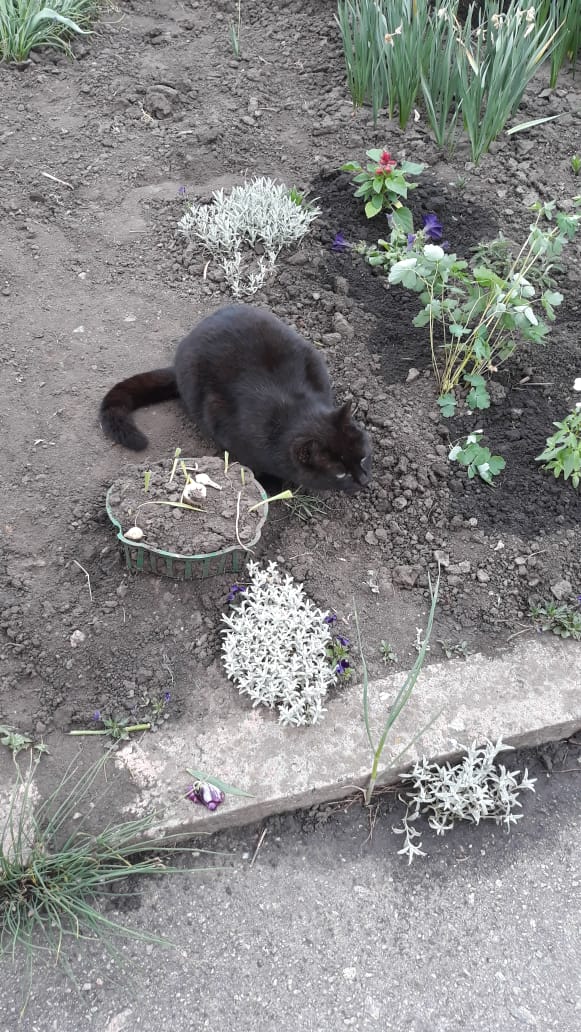
More Garden Pictures

Tanya had a busy day today.  Worked in the garden all day, then went in and wrote to the Veterinary Administration in Dnipro, the City Council in Zhovti Vody, and the village office in Mar'yanivka. The large pig operation about 1 km SE of us is spreading liquid manure on top of the fields instead of injecting it into the ground.  the wind is from the SE and the smell is atrocious. She can't open windows or dry clothes outside. Made me laugh.  That poor pig farmer has no idea what has been turned loose on him.

About 5 years ago, her Irises were taking over the flower beds so she dug them up and planted a single row in the garden, on each side of the path and then across at about 1/3 the way up the garden. She plants most vegetables in the front part of the garden and in back, all the vines, and the corn patch.  The iris all bloomed at once two days ago. They have gone from a single row to several plants wide. She is threatening to dig them up again.


Saturday, May 18, 2019

The Winter War 30/11/1939-13/03/1940

This post is a continuation of my previous post "Soviet/Russian Mythology about WWII- Who started the war?" The Winter War against Finland was a continuation of Russian military conquest of Eastern Europe as divided up under the Molotov-Ribbentrop pact, including the secret agreement to divide Eastern Europe into "spheres of interest" between Germany and Russia.

Finland had been ruled by Sweden for 600 years and by the Russian empire for 100 years. The country had become independent in 1917 and fought and won a civil war against Soviet-backed Communists to maintain its independence. A former General of the Russian Empire, Carl Mannerheim was appointed Field Marshall of the Finnish Military. He understood the only threat to Finland was from Russia and through the Karelian peninsula. A line of strongly fortified casements, fronted by several kilometers of defensive obstacles was built across the peninsula from the Gulf of Finland to Lake Ladoga, about 40 km back from the Finnish border.

Having taken half of Poland and militarily occupied the Baltic States, Stalin next turned his attention to Finland.  The problem, according to Stalin, was the Finnish border was too close to Leningrad and he needed a buffer zone, the Karelian Isthmus, offering to trade a much larger piece of Russia farther North which had little or no value for anything. The Finns refused and Stalin had "no choice" but to invade Finland. This documentary tells most of the story of The Winter War.


The Finns fought the Red Army to a standstill, destroying 10s (if not 100s) of thousands of Soviet soldiers until simply through overwhelming force the Red Army broke through the Mannerheim Line and they were forced to sue for peace. Finland lost 11% of its land area and 30% of its economy, Ceding most of Karelia including all of the Karelian peninsula, including Vyborg, the capital but kept their pride and their independence.

Russian death losses were incredibly high with estimates ranging from 50,000 killed to 250,000 killed and 400,000 missing. The Soviet Union was humiliated and their army revealed as weak and virtually useless at waging war. They were forced to stop short of taking all of Finland.

Suvorov devoted an entire chapter of The Chief Culprit to the Winter War and raises some interesting issues. Why were Soviet losses so high? Yes, the Red Army was abysmally led, poorly equipped, poorly fed, poorly everything but it was the first time in history that a military endeavour of that magnitude was ever undertaken in the far north under winter conditions.

Yes, the tactics of 18th-century massed full frontal assault into 20th-century machine guns didn't work any better than in WWII and the Red Army cared no more for high losses to gain an objective than did the Tsar's army before them but the terrain totally supported the defenders. Roads were few, narrow, heavily mined on both sides. Intense cold, long hours of darkness and deep snow favoured the Finns, camouflaged in white and very mobile on skis.

Suvorov goes into detail about the fortified Mannerheim Line and the number of direct hits it took to destroy them, one at a time. According to him, the casements or pillboxes were 1.5 to 2 meters thick concrete, covered on top with thick steel plate and then with boulders and earth for total camouflage.

Destroying one such position, Pillbox 31, took1043 shells from a 203 MM howitzer and 116 from a 280 mm howitzer, a total of 133 tons of shells plus tons of gunpowder in silk bags. All of which had to be hauled in and handled to the guns, all under fire.  These guns weighed 18 tons and 19 tons respectively, had to be hauled in in pieces and then set up and sighted, all under fire. Stalin asked the Red Army to do the impossible and they did it, but no one gave them credit.

Stalin had achieved his objective which was not Finland but a clear path to the iron mines in Northern Sweden. He stopped when he did (protecting Leningrad) because the Germans had threatened a military response if they thought those iron mines were in danger.

When the Russian Press makes nasty remarks about the incompetence of the Red Army and someone is not immediately shot, perhaps one should question why.  Hitler was ecstatic and believed the Russian army would fold in a matter of a few months. So Barbarossa was launched without preparing for a lengthy war.  Hitler's Hubris cost him the war.

Note: I have not read sufficient books on The Winter War to feel totally comfortable with anyone's version yet. This book is available on Kindle: Finland at War: The Winter War 1939–40 

Sunday, May 12, 2019

Tanya's Garden

I talked to Tanya at 4:00 am this morning (1 pm her time). She had just come back from the market and transplanted tomatoes, peppers, and more flowers before it started to rain again. Zhovti Vody has been getting good rains all week. She said the ground was so soft in the garden she just stuck her hand down to make a hole for the transplant. Corn, beans, beets, peas are all about 10 cm (4") tall. The onions are about 30 cm tall.
Yuri cut the grass in the back yard and around the outside of the garden fence as it was about 1 meter tall. I said we needed to buy a cow.
The tulip pictures she posted on Facebook in early May. They are done now and she will be cutting the tops back and digging them up once it dries out enough.
She had to buy petunia bedding plants this year as she was not home to start them.


Thursday, May 9, 2019

Soviet/Russian Mythology about WWII- Who started the war?

Today is May 9th, which Russia and some other countries of the Former Soviet Union celebrate as the end of the Second World War. (The Western Allies signed Germany's unconditional surrender May 8 but Stalin insisted on a separate signing the following day).

Since it was the only thing the USSR did right (more or less) in 70 years, and really Russia since, Putin is using "The Great Patriotic War" to build Russian support for nationalism and militarism. There is an official version which must not be disputed and archives are kept closed to make sure it is not. The article linked below dispells the 6 major myths spouted by the Kremlin.


One of the big myths is who started the war. Two books by Victor Suvorov shed some not uncontroversial light on it:

Victor Suvorov is a former Soviet-Union army officer who fled in 1978 to England, where he worked as a teacher and adviser for news agencies. Author of a number of bestsellers about the history of the World War II, the Soviet Army special operations troops and military intelligence, and the Red Army, he is one of the historians who believe that Hitler started the war against Russia to prevent Stalin attacking Germany first. (Goodreads)

The Chief Culprit is an expanded version of Ice-Breaker. The pros and cons of his thesis that Stalin was responsible for starting WWII and that Hitler's invasion of USSR was to preempt Stalin's invasion of Europe can be found here en.wikipedia.org/wiki/Soviet. He is beginning to gather some support for his ideas. it is natural that he would be resisted as historians have pretty much stuck to the Soviet line that "they were not ready, Stalin was incompetent, etc". Some Russian historians are certainly opposed to Suvorov and apparently an Israeli one as well. One of the criticisms is that Suvorov doesn't cite his sources. But as he said, forget the documents, simply look at what was done and weigh it as for attack or defense.

If Hitler had delayed the invasion of the Soviet Union by two weeks, the Soviet Army would have been on the English Channel by September. Europe would today be speaking Russian and look much like East Germany prior to unification. That is the conclusion one draws from Suvorov's book.


Anyone with an interest in the history of the Second World War knows the general narrative of the German invasion of the Soviet Union on June 22, 1941. Hitler fooled Stalin into signing the Molotov-Ribbentrop pact, bribing him with the secret protocols dividing up Eastern Europe. 

This allowed Hitler to fight on one front only without having to watch his back and would deal with Russia later. The Germans were so successful in overrunning Western Europe, North Africa, Norway, and the Balkans, that Hitler decided to risk invading the Soviet Union. Destruction of the USSR was his overriding goal all along (see Mein Kampf) - starving 1/3 of all Slavs, enslaving 1/3 and driving 1/3 behind the Urals.


The Red Army was massed along the border with Germany with stockpiles of munitions, aircraft, tanks, etc. The Red Army was badly led, Stalin having killed off all the experienced officers in the 1937-38 purges, and did not have time to prepare defenses. Stalin was convinced Hitler would not attack and disregarded warnings of the pending German invasion, from among other sources Churchill and Sorge, a spy in the German Embassy in Japan, who gave the exact date of the invasion.

The Red Army was caught totally unprepared by the German attack and collapsed in utter confusion, though they fought bravely. It took several weeks for the Soviet Army to get organized and begin to provide any kind of solid defense. They were not helped by Stalin who insisted that there should be no retreat and no territory lost.

Originally scheduled for April, Barbarossa was delayed until late June while the Germans bailed out Mussolini in the Balkans and reinforced the Romanian oilfields. Hitler was convinced that the war with the Soviet Union would be over in 4 months. However, even though in the first few weeks and months of the war, the Nazi's captured over 4 million Red Army soldiers and destroyed or captured thousands of aircraft and tanks, and millions of tonnes of munitions, they were caught by winter at the gates of Moscow.

This is the accepted story from German sources and official Soviet sources. For some reason, no one questioned the official Soviet sources and no one asked the obvious question, "What the hell were the Russians doing between Sept 1939 and June 1941 and more importantly, what were they thinking?"

We know the Soviet Union supplied food and raw materials to the Germans. We know in September 1939 they invaded and annexed eastern Poland, fought the Winter War with Finland, then in 1940 invaded and annexed the Baltics as per the agreement with Germany. They also invaded and annexed Bessarabia which was not in the agreement and which was too close for comfort to the Ploiesti oilfields, Germany's only oil supply.

It is Suvorov's belief that it was Stalin who fooled Hitler into facing west and that Hitler was finished the moment he turned his back on the USSR. Stalin's logic goes back to the very beginning of the Bolshevik Revolution in 1917. Socialism was not supposed to be limited to one country, it was to be worldwide. After Russia, the country most ready for revolution was Germany immediately after the Great War. But by 1920, when the Russian civil war ended, it was too late. The Red Army was beaten back at Warsaw in 1922 and the border established which held to 1939.


Stalin realized that WWII was essential to the spread of Socialism; for Capitalist Europe (Germany, France, and Britain), to destroy themselves. That is why the USSR began helping Germany rearm, contrary to the Treaty of Versailles, long before Hitler came on the scene. It is also why Stalin encouraged the rise of Hitler because he recognized his usefulness to the Socialist cause. Stalin referred to Hitler as the "Icebreaker" who would open the way for a Socialist conquest of Europe.

So when Zhukov signaled Stalin in August that the Red Army was in position to annihilate the Japanese Army North at Khalkhin-Gol (I was there in 1995) on the Mongolian-Manchurian border and ensure Russia did not have to fight on two fronts, Molotov signed the infamous agreement with Molotov.


As a Russian Military Intelligence Officer Suvorov had access to documents that other historians did not or the significance of which they did not understand. Suvorov describes in well-documented detail what the Red Army was doing and what they were thinking. He lists which officers commanded which armies, division, battalions, where and when they were stationed, what their training and equipment was. He asks many questions to which he then applies his knowledge of military strategy and tactics to work out possible answers.

IF the Soviet Union was determined to stay neutral and stay out of the war and their only concern was to defend themselves against German aggression then WHY did they:
  • Move their border up against Germany, rather than leaving a buffer?
  • Abandon and destroy the Stalin-Line of defensive fortresses stretching from north to south, which at least would have provided a fallback line of defense?
  • Train a million paratroopers and establish a marine landing invasion force stationed on the Danube?
  • Train and organize a First Echelon army of millions and secretly move it up against the Border with Germany and Romania?
  • Train and organize a Second Echelon army and secretly begin moving it towards the German border?
  • Build roads and railroads towards the German border and use them to move troops and to stockpile millions of tonnes of fuel, munitions, etc. within 50 km of the border?
  • Build airstrips within 40 to 50 km of the border and part aircraft wingtip to wingtip?
  • Train pilots not in air to air combat but in air-to-ground bombing and strafing?
  • Spend months of detailed planning but have no defense plans?

These are activities of an OFFENSIVE Army, not a defensive army. In other words, Stalin was NOT waiting for Hitler, he was going to attack. Suvorov calculated the date of July 6, 1941. Sunday morning was a favoured Soviet attack time. And according to the railway schedule, the Second Echelon armies would begin arriving at the front July 10, which meant they could actually be unloaded on the other side of the border on German territory. On July 6, the disasters which happened to the Red Army would have happened to the German army.


By May and early June 1941, the actions of both armies on both sides of the border were mirror images of each other. Both sides were well aware of the build-up of the other side. Why didn't Stalin believe the warnings? He had no reason to trust Churchill whose very survival depended on opening of an Eastern Front. Nor did he trust Sorge who had been "recalled to Moscow" months previous but refused, knowing what was waiting for him when he got there.

Stalin did trust his own intelligence officers who were certain an attack would not be launched even if Hitler were foolish enough to want to fight on two fronts. They were monitoring two critical items which they knew Germany MUST have before an attack on the USSR: winter clothing and winter lubricants. Hitler's hubris sunk Stalin.


Suvorov's claims have been disputed as revisionist. The mythology of the Great Patriotic War is that the Soviet Union did not want to fight but was invaded without cause by the German aggressor. Most of the documentation needed to prove Suvorov's version has of course been destroyed, in particular, the detailed plans which every commander along the front had in a red envelope in a safe which was to be opened on command from Moscow. But there are enough clues left to indicate that Hitler attacked when he did to preempt what he knew was coming and that it was just in time.

Until I find a specific detailed rebuttal, I am inclined to go with Suvorov. 

Sunday, April 28, 2019

Robert Duval

Robert Duval was born in 1931 which makes him 88 years old and still kicking. His last movie "Widows" was made in 2018. His Filmography reads like it will take me the rest of my life to watch them all, though I have seen a good many of them before I paid attention to who he was.

The first movie I really 'saw' him in was "Tender Mercies" for which he won an Oscar.  After that, I started looking for his movies. "Second Hand Lions" was and still is one of my favourites. And of course he does westerns with the best.  I have watched dozens if not hundreds of Westerns and have had a hard time picking out my favourite actor. "Lonesome Dove" settled that for me. Duval said it was his best, too.

A few lines from a few movies:

Tender Mercies:
Mac Sledge [to Rosa Lee]  I don't know why I wandered out to this part of Texas drunk, and you took me in and pitied me and helped me to straighten out, marry me. Why? Why did that happen? Is there a reason that happened? And Sonny's daddy died in the war, my daughter killed in an automobile accident. Why? See, I don't trust happiness. I never did, I never will.

 Secondhand Lions
Hub Sometimes the things that may or may not be true are the things a man needs to believe in the most. That people are basically good; that honor, courage, and virtue mean everything; that power and money, money and power mean nothing; that good always triumphs over evil; and I want you to remember this, that love... true love never dies. You remember that, boy. You remember that. Doesn't matter if it's true or not. You see, a man should believe in those things, because those are the things worth believing in.

Hub I'm Hub McCann. I've fought in two World Wars and countless smaller ones on three continents. I led thousands of men into battle with everything from horses and swords to artillery and tanks. I've seen the headwaters of the Nile, and tribes of natives no white man had ever seen before. I've won and lost a dozen fortunes, KILLED MANY MEN and loved only one woman with a passion a FLEA like you could never begin to understand. That's who I am. NOW, GO HOME, BOY!

Open Range

A man's trust is a valuable thing. You don't want to lose it for a handful of cards.
We come for justice, not vengeance. Now them is two different things.
We'll drink to good health for them that have it coming.
Lonesome Dove
“I won’t say I did and I won’t say I didn’t, but I will say that a man who wouldn’t cheat for a poke don’t want one bad enough.”
“Woodrow, you just don’t ever get the point – ‘It’s not dyin’ I’m talkin’ about, it’s livin’.”
“You see, life in San Francisco is still just life. If you want any one thing too badly, it’s likely to turn out to be a disappointment. The only healthy way to live life is to learn to like all the little everyday things – like a sip of good whiskey in the evening, a soft bed, a glass of buttermilk, or a feisty gentleman like myself.”
Well the first man comes along that can read Latin is welcome to rob us, far as I'm concerned. I'd like a chance t' shoot at a educated man once in my life.
I'm just tryin' to keep everything in balance, Woodrow. You do more work than you got to, so it's my obligation to do less

Friday, April 19, 2019

Ford Nation expands to Kenney Country

Well, they got it. Enjoy.
If you thought Peter Lougheed was the best premier Alberta ever had (I did), you voted for Notley.  If you thought Klein was the best, you voted for Kenney.  Klein took the wrecking ball to the Alberta economy and successive premiers pretty much kept the beat. Alberta was a one trick pony, depending on oil revenue and increased debt. When the bottom fell out of the oil prices and jobs disappeared like fog on a hot morning, the province went into a slump. A slump which was not addressed by the federal or provincial government to the satisfaction of Albertans. Global oil prices and lack of pipeline capacity to tidewater and eastern Canada were the big issues. And still are.

Notley and the NDP had four years to clean up a mess not of their making and needed another four years which they did not get.  The UCP did an incredible job of blaming the NDP for the economy.  The fact that the NDP made a number of changes which helped the poor and marginalized, improved education and health care, improved labour conditions and did more for the oil patch than previous governments, counted for nothing.  These changes may have in fact boosted UCP chances as the poor, marginalized and labour are always out of favour in Alberta.

So here are my predictions for the next four years:

  • Taxes will be cut for the wealthy and large corporations and labour will be attacked, all in the name of "job creation"
  • Budgets will be slashed for health, education, social services, in fact, anything that benefits the citizens of the province, especially the poor and marginalized.
  • No pipelines will be built and the "eco-terrorist" NGOs will not only win every court case but enrich themselves with donations as they now have a very visible, hateable enemy.
  • Oil prices will not recover without a war in the Middle East and jobs in oil patch will never recover to previous levels.  Alberta will not return to previous boom days.
  • Republican Jesus theocracy will be the rule of the day on the social front.
  • Violence against POC, Muslims, Indigenous peoples, LGBTQ, and women will increase.
  • All carbon tax court cases will be found in favour of the federal government.
  • None of the above will matter to Albertans as long as they do not have an NDP government.
  • JT's ineptness as PM will throw the election to Scheer and the Conservatives, bringing Ford Nation and Trumpism to all Canada.
These are obviously not things Albertans care about

I will not regret returning to Ukraine in a few months.

Thursday, April 11, 2019

Running Against the Wind


Against the Wind
Seems like yesterday
But it was long ago
Janey was lovely she was the queen of my nights
There in darkness with the radio playin low
And the secrets that we shared, mountains that we moved
Caught like a wildfire out of control
Til there was nothin left to burn and nothin left to prove
And I remember what she said to me
How she swore that it never would end
I remember how she held me oh so tight
Wish I didn't know now what I didn't know then
Against the wind
We were runnin against the wind
We were young and strong we were runnin against the wind
And the years rolled slowly past
And I found myself alone
Surrounded by strangers I thought were my friends
Found myself further and further from my home and I
Guess I lost my way
There were oh so many roads
I was livin to run and runnin to live
Never worried about payin or even how much I owe
Movin' eight miles a minute and for months at a time
Breakin all of the rules that would bend
I began to find myself searchin
Searchin for shelter again and again
Against the wind
Little somethin against the wind
I found myself seekin shelter against the wind
Well those drifters days are past me now
I've got so much more to think about
Deadlines and commitments
What to leave in, what to leave out
Against the wind
I'm still runnin against the wind
I'm older now but still runnin against the wind
Well I'm older now but still runnin against the wind
Against the wind
Against the wind
Still runnin
Against the wind
Against the wind
Against the wind...

Sometimes a song sticks in your head and won't leave you along.  Not an ear-worm. They are common enough.  A song where the lyrics and music come together in a way that speaks to you.  I posted Bob Seger's "Against the Wind" on FB a couple months ago and it has haunted me ever since.

"I wish I didn't know now what I didn't know then". How often have we wished we knew then what we know now.  This line says it better. Regrets for the things you learned the hard way and wish you hadn't.

And who among us hasn't felt at one time or another we were running against the wind? Sometimes I feel like I have always and am still running against the wind.  Mostly of my own choosing and my own decisions. Too old to quit. Or too dumb.

Reminds me of another ditty:

If you're happy and you know it, overthink.
If you're happy and you know it, 
Give your mind a chance to blow it.
If you're happy and you know it over think.