Part 1 is here.
The population of Canada after the Second World War was
12-15 million, including one million Ukrainians, who emigrated to Canada from
the displaced persons camps. The goal of these new Ukrainians was to establish
themselves as Canadians and fight the communist regime to free their Ukrainian
brothers. The Committee of Ukrainians of Canada united several dozen Ukrainian
organizations who worked hard at spreading the word about their community and
the situation in Ukraine SSR, debunking Soviet propaganda.
The Soviet Union, specifically the KGB, the Soviet Secret Police
launched Operation Payback sometime in the late 1970s. They were concerned with
the cooperation between Ukrainian dissidents and human rights activists inside
the Soviet Union and Jewish Refusniks. The combination of those two groups of
dissidents and human rights activists inside the Soviet Union if supported by
the Ukrainian, Baltic, and Jewish diasporas could cause them problems. Operation
Payback had two goals.
1.
The primary goal was to divide Ukrainians and
Jews spreading accusations that the Galicia Division murdered Jews.
2.
Dividing Ukrainians and Poles by claiming that the
Galicia Division was responsible for ethnic cleansing of Poles was a secondary
goal.
The Soviets viewed all anti-communist Ukrainians as Nazi Banderites,
followers of Stepan Bandera and the OUN (National Organization of Ukraine). OUN's
goal was to drive out occupying powers and set up an independent Ukraine. OUN
accepted violence as a political tool against enemies of their cause. The
military wing of the OUN , the UPA (Ukrainian Insurgent Army) fought as
partisans against the Poles, the Nazis, and the Soviets. Some units were involved
in killing Jews, others had Jewish members. The UPA was very active in ethnic
cleansing of Poles (and the Polish Home Army in killing Ukrainians), killing some 50,000 to 100,000. The last of the UPA were
destroyed by the NKVD in the early 1950s. Polish-Ukrainian relations have been strained over this ever since, with no agreement.
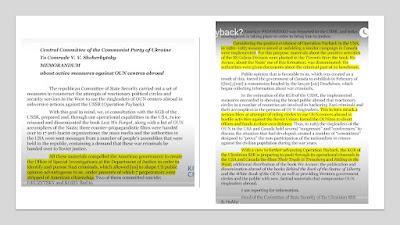 |
| KGB memo on Operation Payback |
The KGB began inserting what we would today call fake news
stories into the Western media, circulating leaflets and films, planting
stories in newspapers. For example, the number of imaginary criminal Nazis grew
to as many as 6000. The whole intention was to raise this question of thousands
of Nazis or alleged Nazis hiding in North America. Jews in North America rallied
to weed out these villains in our midst. That provoked a struggle between the
Jewish communities and principally the Ukraine diasporas.
Operation Payback was highly successful The Ukrainian
Diaspora had to halt their attacks on the Soviet Union and concentrate on
defending themselves. Pressure from the Canadian public, in particular the Jewish
communities forced the government to investigate. And the lies and misinformation
continue to circulate.
The Royal Commission on War Criminals in Canada, headed by
Jules Deschenes, began in February 1985 under PM Brian Mulroney. The work of
the commission was based on the principles of the Nuremberg Tribunal. The
Deschene Commission compiled a list of persons who were accused of possibly
committing war crimes — a total of 883 people. In addition to Ukrainians, the
list included Hungarians, Lithuanians, Latvians, Estonians and representatives
of other nationalities.
Of the 217 divisionists who were challenged by the
Wiesenthal Center before the Canadian government, 187 had never been to Canada,
11 died in Canada, two left for another country, 16 had no evidence of war
crimes, one had no information of any kind.
The Deschenes Commission report was released in 1987. Of
966-pages, eleven of them were devoted to Waffen SS divisionists. The first
part of the report dealt with making it easier to deport war criminals. In the
second part of the report, the Commission reached several important
conclusions:
- 1. There is no reason to accuse the Waffen-SS
division "Galichyna" of crimes against humanity and war crimes, as before
entering Canada, former divisionists were thoroughly checked twice, once in
Italy, once in Britain.
- 2.
In the absence of evidence of the commission of
specific war crimes, membership in the division itself is not sufficient
for prosecution
- 3.
There can be no prosecutions for the purpose of
depriving members of the Waffen-SS Galicia division of Canadian citizenship or
deporting them.
It is unknown whether Yaroslav Gunka was on the list of the Deschenes
Commission. Since they were guilty of nothing they had been accused of, surnames
were noted in the secret part of the report, which has not yet been
declassified to the public.
Dr. Lubomyr Luciuk, Professor at the Royal Military College of
Canada, (interview link in the References Part 3) had just moved to Toronto after
finishing up his PhD at the University of Alberta in 1984. His dissertation was
on the post War II immigration of Ukrainians to Canada, the so-called displaced
persons or DPS including Veterans of the Division, so he was very well informed.
He'd studied the archives; interviewed veterans of the Division and many other refugees
who came to this country after the Second World War.
During the Commission’s investigations, Dr. Luciuk worked
with The Civil Liberties Commission, which was associated with, but independent
of, the Ukrainian Canadian Congress. Some of Dr. Luciuk’s comments about the
Deschenes Commission are in the following two paragraphs (not verbatim).
The principal position of the Civil Liberties Commission was,
and remains, that the concerns of the Canadian Jewish Congress are understood.
No one wants any war criminals in Canada. If there is credible evidence that a
person committed a war crime or a crime against humanity, put that before the
authorities, let the authorities review it, and determine if that person should
be brought to trial and if so in a Canadian criminal court of law.
All these grossly exaggerated figures that were banded about
were dismissed by Deschenes Commission. The reality is virtually all the cases
that he looked at were submitted by individuals who provided no evidence at all.
They would denounce people, they'd name people, they'd say we read it in a
newspaper published somewhere in Eastern Europe. Many of the cases were,
“This man was a veteran of the Galicia division, although there's nothing
against him personally.” We'd get anonymous tips. Deschenes would
investigate them and, in some cases, he'd go to the person who said, “Well,
that guy is a Nazi.” “What is your evidence?” “I don't have any, I just think
so”.
The Speaker of the House made an innocent and unfortunate mistake,
took responsibility for it, and resigned. The furor, now international, is
continually fed by the Kremlin propaganda machine. It benefits no one but
Putin. Yet Russia needs to be continually reminded that it was the Molotov-Ribbentrop Agreement and Soviet support for the Nazis that allowed Hitler to begin the war.
Mr. Yaroslav Hunka and the other members of the Waffen SS
Galicia Division, living and dead, who immigrated to Canada, were and remain, Ukrainian
Patriots and Heroes.
References in Part 3 here.


