Showing posts with label Remembering the Farm. Show all posts

Tuesday, February 26, 2013

Dollars to Doughnuts


There is always one smart ass in the crowd who likes to spoil things. My blog from a couple days ago elicited a response i didn't expect.  This morning I had an email waiting from Dr Dave Christensen with a link to a claim that the picture on the 1954 Canadian $1 dollar bill was actually from Alberta.  I should have known he would find something.  I wrote some time ago "Dave doesn't solve problems; that is what grad students are for. His job is to give them problems.  I know this".

Here is what the link had to say:

Bluesky is in the Peace River Country of north western Alberta just north of the banks of the Burnt River, NW of Edmonton. The scene on the back of the old (1954) Canadian dollar bill is of Bluesky. For those unfamiliar with the back of the old Canadian $1 bill, the scene illustrated is taken from a few miles east of Bluesky looking west towards Fairview on NO.2 highway. The elevators at the end of the dirt road stand out silhouetted against the western skyline with a dark cloud hanging over a typical Peace River sunset.

Albertans would claim that Christ and eleven of the twelve apostles were from Alberta; (Judas being from Ontario), so the notion they would try to claim the Saskatchewan prairie dollar is quite in keeping with their provincial character.

I tracked down the author; no easy task as the website had no contact information and emailed him to provide documentation for his claim.  I also asked “Saskatchewan Farmboy” for documentation that in fact the picture was of Fleming and old Number 1 Highway.  Him I heard back from, twice already with the following two links.

Wikipedia identifies it as “Saskatchewan prairie”, original source being The Charlton Standard Catalogue of Canadian Government Paper Money, Tenth Edition, p.206, edited by W.K. Cross, The Charlton Press, Toronto, ON, 1997, ISBN 0-88968-190-2.

The late Ron Petrie, wrote the following column for the April 25, 2011 Leader Post:
For an entire generation of Saskatchewan children, the green dollar bill with its backside depiction of a storm brewing over prairie landscape was wealth itself, enough money on a Saturday afternoon for a three bottles of pop, seven licorice whips, two bags of Cheezies and a stomach ache (plus bonus agony, if dad didn't believe that you spent the buck at the barbershop, as instructed, for touch-up on the old buzzcut).

Never has one image of Saskatchewan been more widely viewed by the rest of Canada than that panoramic view on the back of the dollar. Nor has any banknote been the subject of more urban legend.

On all denominations in the 1954 issue, squinting Canadians swore that in the curled hair above the left ear in the portrait of a young Queen Elizabeth II, they could make out the ghostly countenance of the devil himself. Story had it that the man who engraved the banknote's plate was a mischievous anti-monarchist from Quebec.

Nonsense, according the Bank of Canada. Also without any proof are the stubborn claims by dozens of towns in Saskatchewan that their community was the one depicted on bill's distant horizon, at the vanishing point of a dirt road and telephone poles.

The village was a creation of the artist's imagination, says the bank. To this day, however, the one community that most adamantly claims ownership is also one of my favorite towns, Fleming. Patrons of the historic Windsor Hotel beverage room say they can even prove Fleming was in front of the artist's easel, with simple a test: if you step out the hotel's front door, gaze straight east while holding the old dollar bill at eye level, and then wave frantically, in the bill you'll spot your own self waving back. (The test is also useful in determining whether you're OK to drive home from the Windsor.)

I’ll go with Fleming. Wiki can be questioned but not Ron Petrie.

Update Feb 27, 2013:  I heard back from Ralf Brooks who assured me his claim was correct, based on that most accurate of prairie sources:  legend, hearsay and tradition and besides "some of his family were there".  Many thanks, Ralf, and I look forward to what you learn from Senator Jean Leo Cote's book.  I shall do a blog post about your father soon too, if you don't mind.

Update August 2019: That the picture of the elevator on the 1954 dollar bill is of the Fleming elevator is confirmed:

Email dated Monday, August 19, 2019 7:14 AM


The town featured on the $1 bill is Fleming Saskatchewan which is located on the Manitoba border.
The town was famous for its iconic grain elevator, visible on the bill, which sadly burned down in 2010.

Sincerely,
Scott Thomas
Visitor Services Coordinator | Coordonnateur des services aux visiteurs
Bank of Canada Museum | Musée de la Banque du Canada 
ScottThomas@bank-banque-canada.ca

Tel./Tél. : (613) 782-8914
30 rue Bank Street, Ottawa (ON) K1A 0G9
bankofcanadamuseum.ca | museedelabanqueducanada.ca


Saturday, February 23, 2013

Remembering the Farm: Prairie Elevators - the Sequal

In July last year I blogged about the old wooden grain elevators that dotted the prairie of my youth. My lead was the 1954 Canadian $1 bill, the back of which pictured a gravel road with elevators in the background.

Canadian 1954 $1 bill
To my delight, this morning I got an email with pictures from "Saskatchewan Farmboy" with information about the picture on the dollar.  He sent me some references and I found a couple more.


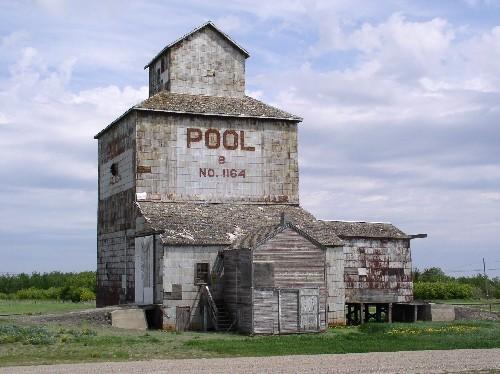
Hi, I stumbled across your blog about the grain elevators on the back of the 1954 $1. The town is Fleming, SK and that gravel road is actually the #1 highway. One of the elevators was one of the first built in Canada by "Lake of the Woods Milling Company". Up until a couple years ago it was the oldest standing elevator in the country. If I remember correctly, it was built in 1895. My Great, Great Grandfather, Great Grandfather, Grandfather, and Father all hauled grain there. (My family has been here since 1871). Eventually there was a fourth elevator built in the line-up but it was after the photo was used for the back of the $1
Picture from kenoradave (see below)
Picture from Saskatchewan Farmboy

 I'm not sure when Saskatchewan Wheat Pool took it over but they had it before UGG. When United Grain Growers took her over, they used it for fertilizer storage. There's a photo taken of a Super B grain semi unloading in the driveway of this elevator......both ends of the unit were hanging out each side, looked like a giant snake but the old wooden scale was still strong enough to hold about 64,000 kgs!!

Picture from Saskatchewan Farmboy.  Prior to renovation

Picture from Canada's Historic Places (see below)
It was deemed a national historic site in 2008 and the community was in the process of restoring the old girl for tourism (top pictures). With only a few months left to go before she would open for its first visitors, vandals set her on fire and it burnt to the groundThree young men were caught, charged, and convicted for the death of our historic elevator.
Picture from Saskatchewan Farm Boy
A part of our countries history was lost forever that night. It was one of the few that had been saved from the wrecking crews.

Back in the day, the town of Fleming was being considered for the capital of Canada, it was a boom town. A water supply issue and a fire made sure it never would see that glory. Now the population is less than 80 and the only business left is the hotel/bar which my Great Great Grandpa built. 

November 28, 2009, This elevator is one of the last vestiges of the old Lake of the Woods Milling Company. At one time the company flour mill in Keewatin, Ontario was the largest in the world. The flour mill burned in the sixties and that was the end of it. There are still a few of the old mill buildings remaining in Keewatin. No idea why this elevator is still standing. 
March 6, 2011, Seems I managed to grab this shot just in time. The elevator that stood like a monument alongside the TransCanada Highway in Saskatchewan burned down three months after I took the picture. I miss it every time we drive by. With the Lake of the Woods flour mill gone and now this elevator there won't be much evidence left of that part of our history.

More information besides the following paragraph is available at Canada's Historic Places.
Fleming Lake of the Woods Grain Elevator National Historic Site of Canada is a wooden, hipped roof grain elevator, located along the Trans-Canada Highway, five kilometres west of the Manitoba border. It is situated south of the Canadian Pacific Railway (CPR) mainline, between the highway and the community of Fleming, Saskatchewan. This National Historic Site was demolished by fire in February 2010. The formal recognition consists of the grain elevator and a small area of surrounding property.


Wednesday, October 31, 2012

Remembering the Farm - Reading opens every door.

Author Lynda Beck Fenwick (blog HERE, Facebook page HERE) has written several blog posts and Facebook comments about the importance of education in both homesteading times and today.  She emphasizes the role of literacy and accompanying love of books in formal education and in continuing one's education throughout one's life.

That got me thinking about reading and books in my own life and the lives of my children.  Before I started school, I drove my mother crazy with questions.  I wanted to know everything and especially WHY?  Once I started school and learned to read, her life was much simpler.  By the end of Grade 2, I was reading at an adult level, which is to say, anything around the house.

Reading was a struggle for my father.  I don't recall him reading anything other than farm papers and The Bible.  He preferred to read early in the mornings when he felt at his peak.  One of the weekly farm papers ran serial fiction, one of which was called "Death and the Gentle Bull" featuring a Black Angus bull.  Dad had to read that and got hooked on the story.  We teased him ever after about "getting up early in the morning to read a murder mystery.

Mom loved to read.  I have no idea how or even if she did anything to foster my love of reading other than make sure there was lots to read.  The farm papers, Canadian Cattlemen, Country Guide, The Western Producer, Free Press Weekly, and  Family Herald (the latter two ceased publishing long ago) interested me, especially as I got older.  But Macleans and Chatelaine magazines interested me from day one.

They were quite different then from today's versions.  Both were monthly or bi-weekly, I forget which. Macleans was more literary than news magazine and I loved the stories and articles. Chatelaine was targeted at the 1950's housewife with a great deal of human interest and educational stuff.  Especially educational stuff.  I have no idea if my parents ever had "the talk" with my younger siblings but mom knew I was getting my education from Chatelaine so she didn't worry.

My first real book was Black Beauty which I got for my 7th birthday.  I had two Robin Hoods; one by Howard Pyle and one by Henry Gilbert.  Preferred the latter as I grew older.  Kipling's The Jungle Book or All the Mowgli stories was another favourite.  I was about 11 or 12 when someone gave me Zane Grey's "Spirit of the Border" and I was HOOKED.  Read a great many of his books, graduating over the years to Ernest Haycox (the best) and Louis L'Amour.  Westerns are still my reading to relax genre.

Dad was able to buy us the World book encyclopedia in the late 1950s.  He had no money but managed to find enough for the cheapest no frills set.  The lady who sold them was someone Dad had worked for back in the 30s and I think gave them to us at cost. It was our "internet" and provided hours and hours of reading.

No idea when I joined "Book of the Month Club" but was a member for over twenty years, maybe more.  My library was starting to grow.  Used book stores and the bargain shelves helped add volumes without exorbitant cost.  Couldn't say exactly when I morphed into history but by my mid-20s for sure.  If I had it to do over, maybe I wouldn't have taken Animal Science but History instead.  though reading it is likely more fun than writing it.

Ella was also a reader.  Mostly human interest stuff, biographies, that kind of thing.  And Harlequins. And Royalty.  When our kids came along the house was full of books and we made sure that there was lots for them to read too.  Little Golden Books, Berenstein Bears and Dr Seuss.  I can likely still recite Hop on Pop or Hand Hand Finger Thumb.

Likely I am responsible for warping my kids' minds with my interpretations of their books. The Three Bears opened with "Once upon a time there were three bears who lived in a house in the woods. Papa Bear pounded nails in the roof; Mama Bear watered the flowers and Baby Bear did tricks on the lawn".  I would explain to the children that I had no idea who Tricks was and that since she was never mentioned again must have been unimportant.  This horrified adult listeners but the children were oblivious.

The public library became a favourite haunt.  When we lived in Kindersley and our youngest was a wee new babe we had a blizzard that shut down the town.  So we bundled the kids and pulling two on the toboggan, we walked through the drifts to the Library - which was actually open.  When we moved, the Regina Public Library closest to us soon knew us all by name and our tastes by heart.

Our house continued to fill with books.  More and more shelving units were added.  One NEVER discards a book.  EVER.  The kids used to say that for any topics concerning WWI or WWII they had only to go to my books for their highschool reports.  They began accumulating their own libraries and by the time they began moving out it was "20 boxes of stuff and 20 boxes of books".

My oldest daughter has similar reading tastes to her mother.  After two degrees (Human Justice and Social Work) she swears she will never read anything on purpose from which she might learn something but on occasion she lies. My son reads history like his father but likes good novels even more.  If you take any newspaper's "Top 100 novels ever written" he has likely read 75 of them.  His thinking ability is far ahead of mine.  History helps me understand what happened and why.  Novelists invent the future.

My second youngest daughter is finishing off her dissertation for a PhD in Victorian Literature.  Everything between Jane Austen (pre-Victorian and L.M. Montgomery post-Victorian.  And my youngest daughter took her history degree and a Masters in Library Tech and is now a Librarian in a highschool in London England. She specializes in reading Young Adult books as those are her students' reading material. Oh, yes, and Harrius Potter et Philosophi Lapis.  (By the way, LynnieC, there are several new Latin translations of Harry Potter books available).

When I get a little money I buy books; and if any is left I buy food and clothes.     Erasmus

Tuesday, October 16, 2012

Prairie School by Lois Lenski


Sometimes a kids' book is not just a kids' book.  I last read Prairie School by Lois Lenski almost 60 years ago.  It was 1954 and I was a Grade 2 kid in a one-room prairie school that my father had last attended some 20 years before.  The book came in a box of books from the school board office which had to be read and returned within the month. I never forgot the book. My kids found it on E-Bay for me for Christmas one year not long ago, 1951 hardcover, exactly as I remembered it, and I read it again just now.

In the Foreword, Lois Lenski explains that in May 1948 she received a letter from Maple Leaf School, a "one-room rural school in South Dakota, just west of the Missouri river and near the North Dakota state line".  The pupils wrote to tell her how much they liked Strawberry Girl which the teacher read to them when it was cold and they gathered around the large floor register over the furnace to keep warm.  Ms. Lenski received other letters from the students of Maple Leaf School in school year 1949-50, describing the terrible winter and their life on the Dakota plains.

She determined to write their story and inspite of delays of snow storms into May, she made the trip, met the students and their families, observed during class, slept in the teacherage.  Prairie School is a composite of their stories.  Maple Leaf School became the model for "Oak Leaf School".  The community was mainly German-Russians from the Odessa region of what is now Ukraine who settled there in the early 1900s. Their language and customs are captured by Lois Lenski's dialogue and also her wonderful pencil sketches.

 Eleven kids from 6 to 13 from six families came on horseback or horse drawn cart or walked in summer and winter.  Farm work interrupted school work for the older boys. The winter of 49-50 was long and hard; the Christmas Concert was cut short because of weather; school was closed often due to weather and once the children were caught and had to stay at the school. Spring was late but never-the-less arrived and the meadowlarks sang. The book ends (for me) with sadness and a feeling as empty as the school. Oak Leaf School (and Maple Leaf School) closed at the end of the year and the kids were bused to town in the fall.  As Miss Martin, the teacher, said "You must grow up and go on to better things".

Ten years later, the one-room rural schools were closed in our school district (which, by the way, was mainly German-Russians from the Volga who came to Saskatchewan in the early 1900s) and the kids bused to town.  I was in Grade 8 by then.  Prairie School described a piece of my own childhood and reading it was like a trip back in time.

Sometimes a kids' book is not just a kids' book. Sometimes it is a reminder of how life was.  Anyone who did not grow up on the prairies and who did not go to a one-room school will find the book interesting, even though it is intended for "8 to 12 year olds", but not nearly as meaningful as for those of us who shared the experiences.


Wednesday, July 25, 2012

Remembering the Farm: The Era of Wooden Elevators

Canadian One Dollar Bill 1954
The picture on the back of the 1954 Canadian $1 bill was always a favourite of mine. The narrow gravel road could have been anywhere in the province, with the telephone lines on one side, the power lines farther out in the field on the other side, steep narrow grass-filled ditches and the grain elevator in the background.

The wooden grain elevator, of which hundreds dotted the landscape at regular intervals, was part of my boyhood.  Originally towns (and elevators) were located every 7 miles or so along the railway tracks so that farmers would not have so far to haul their grain in the days of teams and wagons.  Saskatchewan Wheat Pool (SWP), a farmer-owned cooperative, had by far and away the most elevators which were all painted a dull red until sometime in the 60s when they modernized them all to silver.  I felt we lost a bit of our history when that happened.  Little did I know...

1935 calendar.
SWP issued a calendar showing their governance districts and all their elevator locations.  Every year there would be fewer locations as small centres closed, a result of better roads and increased numbers of farm trucks.  As rural communities died, the elevator and post office were usually the last services to go. You will never read the names on the calendars but you may be able to see the frequency of towns along the rail lines.  And note too the disappearance of branch lines.

1975 calendar


When I started school at Cavell, 2 1/2 miles from home by road, 2 miles cross country, the same one-room school my father attended, there was still a railway station, post office, general store (with 10 gallon manual gas pump), two churches and two elevators, both SWP.  One elevator was soon moved to act as an annex to the other so there was only one "elevator agent".

When my Grandpa Johnson quit farming in 1955, Dad bought his '49 Merc one-ton with a hoist.  Up until then we hauled grain with two wagons behind the Massey 44 or one wagon with the team when roads were bad.  The elevator had a hoist to empty trucks and wagons that had none.
Typical elevator, now at North Battleford Western Development Museum


I liked going with dad when he hauled grain, especially in winter.  The two-story office building (silver, to the left above) was always toasty warm.  The water-cooled stationary engine was on the lower floor, connected to the leg by a wide belt which ran under the walk way between elevator and office.  The "leg" (see 3 in photo below) was an endless belt of metal buckets that "elevated" the grain to the top of the elevator, where is could be distributed to bins as desired. You knew when the  agent was loading cars and might have room for grain as you could hear the putt-putt-putt all the way to our farm on a quiet day.

Simplicity itself.  Other than the leg, it was all gravity flow
The picture above shows a top loading grain car.  In the "olden days" grain was shipped by boxcar which was loaded through the sliding side doors with a great deal of effort.  The inside was marked with lines for the allowable depth of grain depending on weight/volume with wheat the heaviest and oats the lightest.  So when someone says they are "full to the oat line" you know they are FULL.

The roads got better; three ton and five ton trucks replaced the one tons; towns got farther apart.  Cavell disappeared bit by bit and Dad started hauling to Landis, 7 miles away, which had two elevators, one SWP, one "Line" ie a corporation.  He didn't like the Pool agent there so hauled to the other elevator company.

The Canadian Wheat Board (CWB) handled all purchases and sales of wheat, barley and oats.  Elevator companies acted as their agents.  There were great advantages to this arrangement.  CWB was the sole seller of Canadian wheat on the world market and could demand a premium price.  Farmers were given an initial price up front and a final price at the end of the year so every farmer got the same money for every bushel sold whether in fall or spring.

As there was limited room at the elevators, farmers were allotted quota based on CWB sales and acres registered in the "Quota books".  In fall every one could haul 6 bushels per quota acre, then depending on sales and the availability of boxcars, extra quota would be announced throughout the year.  Excitement was learning that there were "six boxcars" on the elevator siding and  that the CWB had announced a 2 bushel increase in quota.  When everything worked the bins would be empty of last years crop by the start of harvest.  It didn't always work that way, of course.

SWP Elevator at Swift Current
Elevators continued to close and the remaining ones got larger.  Old putt-putt-putt was replaced by multiple electric motors, more bin space was added, dust collectors became mandatory.  They even got computers.  My Uncle Vince who was an SWP grain buyer for most of his working life called his computer Jennifer because it wouldn't bring him coffee either. (WKRP fans will get this). The picture above is a good example of the epitome of wooden elevator modernization.

About 30 years ago, the "Inland Terminal" became the new standard for grain elevators and the wooden elevator was doomed.  Sidings that would hold 50 to 100 grain tank cars cut railway freight costs compared to the days of collecting five or ten boxcars at a time.  Farmers any distance from these giant elevators found it cheaper to contract their grain hauling to commercial trucking firms.  Elevators closed and were torn down, branch lines closed and were pulled up.  the days you could look in any direction and see the next town or the next three towns because of the wooden elevators, were history.

In a cooperative, equity is a liability not an asset as it is owed to the members on retirement. As such it is not useful as security to a company needing money for expansion or modernization.  SWP was in a bind as it needed to replace its aging fleet of wooden elevators to be competitive.  As well many of its members were reaching the age of retirement.  Paying out all the equity owed would bankrupt the cooperative.  It became a corporation and all equity was converted to shares.  Do not ask how that turned out for older farmers.

Viterra Elevator at Assiniboia

Other farmer owned elevator companies were going through the same struggles and eventually Manitoba and Alberta Wheat Pools joined forces with United Grain Growers to form one company.  Which was then bought up by SWP, becoming Viterra in the process.  The days of farmer-owned grain companies were over in Western Canada.

Viterra is in process of being bought up by Swiss based Glencore, a commodity trading house giant with annual revenues in 2010 of $145 billion, which controls 3% of the world's daily oil consumption and 55% of the world's zinc and 36% of copper trade.

And I felt bad when SWP painted their dark red elevators silver.


Thursday, June 21, 2012

INTERESTING FACTS ABOUT AIRLINES, AIRPORTS AND AIR TRAVELING

Another cut and paste blog.  Busy chasing potential projects today.  Don't know how much of this stuff is true but it was interesting.  At least now I know why they dim the lights and open the window shades on take off and landing.


INTERESTING FACTS ABOUT AIRLINES, AIRPORTS AND AIR TRAVELING

• All International Airline Pilots speak English.


• Flights longer than 8 hours require 3 pilots (1 captain and 2 first officers) to rotate flying duties. Flights longer than 12 hours require 4 pilots (1 captain and 3 first officers). They usually fly 3-4 hour shifts. (
There are different norms of Indian companies Pilots)

•Each airline pilot flying the aircraft, eats a different meal to minimize the risk of all pilots on board being ill.

•On average, pilots fly between 9 and 14 days a month
(Indian companies pilot fly 24 to 26 days)

•All airlines have an agreement to let each others' travelling pilots occupy empty seats. If no seats are available, the travelling pilot can also occupy an extra seat in the cockpit that is usually empty.


•The main function of flight attendants are for the safety and security of their passengers, and passenger comfort is only secondary.

•The first female flight attendants in 1930 were required to weigh less than 115 pounds. In addition, they had to be nurses and unmarried.


•Flight attendants must not have any tattoos visible when a uniform is worn. These requirements are designed to give the airlines a positive representation.

•The normal ratio of Flight Attendants to passenger seats is one Flight Attendant for every 50 passenger seats.


•The height requirement for Flight Attendant is for safety reasons, making sure that all flight attendants can reach overhead safety equipment.

•The normal ratio of Lavatories to passengers is approximately one lavatory for every 50 passengers.


•An air traveler can lose approximately 1.5 liters of water in the body during a three-hour flight.

•The reason why the lights are turned out during takeoff and landing – Is for your eyes to adjust to lower levels of light. If there's an accident and they have to activate the emergency slides, studies have shown that you will be able to see better and therefore be able to evacuate more quickly and safely.


•The World’s largest Airline in terms of Fleet Size is Delta Airlines (United States) with 744 aircraft and 121 aircraft on order as of March 2011.

•The largest passenger plane is the Airbus 380 - nearly 240 feet long, almost 80 feet high, and has a wingspan of more than 260 feet. The double-decker plane has a standard seating capacity of 555 passengers.


•The world’s busiest airport in terms of passenger volume or the number of takeoffs and landings, is Hartsfield–Jackson Atlanta International Airport, Atlanta, Georgia, United States – with more than 88 million passengers shuffled through the Atlanta airport in 2009, with another 20 million in the first three months of 2010, and with aircraft take-off and landings approximately every 37 seconds.

•The Internet/On-Line check-in was first used by Alaskan Airlines in 1999.

•The world’s Largest Airport is Kansai International Airport, Osaka, Japan (as of 2011). By 2013 Al Maktoum International Airport in Jebel Ali, Dubai, United Arab Emirates is planned to be the largest airport in the world.


•The airport with the longest runway in the world is Qamdo Bangda Airport in the Peoples Republic of China with 5.50 kilometers in length (as of 2011).

•American Airlines saved $40,000 in 1987 by removing 1 olive from each salad served in first class.


•In 2009, Southwest served 63.2 million cans of soda, juices, and water; 14.3 million alcoholic beverages; 14 million bags of pretzels; 90 million bags of peanuts; 17.7 million Select-A-Snacks; and 33.5 million other snacks.

•Singapore Airlines spends about $700 million on food every year and $16 million on wine alone. First class passengers consume 20,000 bottles of alcohol every month and Singapore Airlines is the second largest buyer of Dom Perignon champagne in the world.

•Cathay Pacific carries rice cookers, toasters, cappuccino makers and skillets on board their airplanes.

•KLM of Netherlands stands for Koninklijke Luchtvaart Maatschappij (meaning Royal Dutch Airlines).


•KLM is the worlds' oldest airline established in 1919.

•QUANTAS - Australia’s national airline, originally stood for Queensland And Northern Territories Air Service.


•QUANTAS is the second world’s oldest airline established in 1920.


•QUANTAS still has the world's best safety record with no crashes as of 2011.

•Virgin Atlantic lists catering as their third biggest expense, after fuel and maintenance.


•American Airlines spent about $425 million on food for domestic passengers in 2001.


•In one year, British Airways passengers consume:
* 40.5 tons of chicken
* 6 tons of caviar
* 22 tons of smoked salmon
* 557,507 boxes of chocolate
* 90 thousand cases (9 liter cases) of sparkling wine.

•Abu Dhabi Airport Services once did a complete turn-around for a Boeing 777 in under 40 minutes, as opposed to a normal minimum of one hour. They unloaded passengers, cargo, mail, cleaned the aircraft, and loaded outbound passengers, cargo and mail in that short time.

•In 2001, Dubai Duty Free sold 1,570,214 cartons of cigarettes, 2,003,151 bottles of liquor, 2,909 kilograms of gold, 101,824 watches, 690,502 bottles of perfume, 52,119 mobile phones.

•In-flight catering is an $18 billion worldwide industry employing up to 200,000 people.

Sunday, June 17, 2012

Remembering the Farm: My Mother Grows Zucchini

For whatever reason, zucchini was never part of our lives.  Mom was about 60 when she first decided to try growing it.  She planted a whole row of hills and they all came up and were growing nicely.

She called my sister in Calgary, all upset at my father and at his cows because the cows had got into the garden and destroyed all but three hills of zucchini.  My sister was laughing so hard she could not speak.  Mother was getting quite peeved with her for her lack of sympathy over losing most of her zucchini.  "What is so funny?!!!"

My sister managed to gasp out "You will find out" before my mother hung up.

And she did find out.  And by freeze up, my mother was quite thankful to the cows for saving her and wished they had taken two more hills out, leaving her with only one.

She even laughed about it.

Friday, March 23, 2012

Remembering the Farm: Cavell, Leipzig and School Prayer

The one-room school in the now disappeared community of Cavell, where my father almost completed grade 8 and I completed grade 7, is now a museum in Wilkie, a small town about 15 minutes away (30 minutes when I was a kid).  My sister (who never attended Cavell) took pictures when she was there lately.  I was looking at them on FB, stole the two below and it got me thinking about my school days and the then non-issue of religion in schools.

My father was hunting crows eggs in the spring of his grade 8 year, fell out of a tree and broke his arm, so could not write the final exams.  The teacher gave him his grade on condition that he NEVER return to school. I managed to complete Grade 7. They closed the school in June of 1960 along with several other one room schools and we were bused to now disappeared community of Leipzig about 7 miles away where I took my Grades 8 to 12..

Leipzig was a Catholic community, mainly of Volga Germans and others from Germany directly.  There were a few Lutherans in the mix, I believe as there was a Luthern church in town. The Saskatchewan Mother House of the Sisters of Notre Dame was located in Leipzig and the Sisters were our school teachers.  The school was a Catholic school in the Public School system because the vast majority of kids were Catholic.  Religion was taught from 3:00 to 3:30 and we heathen Protestants could do our homework under the watchful eye of one Sister Martina.

Cavell was just a regular public school while Wilkie had a Catholic School under what was known as a Separate School Board and a public school under the Public School Board.

I had often wondered about the fuss today about so-called Christian Schools, where parents don't want their children going to a public school.  I finally realized that in my father's and my time in our part of Saskatchewan there were only Christian Schools - either Catholic or Protestant, with Protestant being the default public school type. Because there were no other religions in rural Saskatchewan.

Religion was not taught per se in the "Protestant" schools as in the Catholic schools but certainly the values were, more indirectly than deliberately.  And looking through my father's old readers and even my Grade 7 and 8 readers, there were excerpts from the KJV Bible which were taught as literature.

At Cavell, if my memory serves me correct (and I hope someone can verify as I am old and my memory sometimes recalls things that didn't happen), in the morning we stood at our desks and sang Oh Canada and said the Lord's Prayer (long version).  When we went to Leipzig, we gathered in the hall in the morning and sang Oh Canada and said the Lord's Prayer (short version).  It was not a problem for our parents because we all to a greater or lesser degree, subscribed to some version of Christianity.

I suspect that this held true for all parts of Canada at some time in their history.  However, as more people moved to Canada from all parts of the world, unless they were Catholic, their kids ended up in the Public School system effectively diluting the Protestant only make up.  So we have public schools with Protestants, Roman Catholics, Eastern Orthodox, JWs, Jews, Muslims, Buddhists, Hindus, and two dozen other kinds I have never heard of along with people who don't believe in any kind of God or gods.

It is no longer one size fits all.  The world has changed and we have to change with it.  If there is going to be prayer in the schools, then everyone has to divide up into their own groups and pray their own prayers or else no prayers at all. Christmas is THE most important festival season in the Christian world.  School Christmas Concerts used to have bits and pieces about Christmas - carols and mangers and such.  Not any more.  I kind of miss it but recognize that public schools are for all students and must take into account the beliefs of all students as best as possible.

The folks that are hostile about all this, claiming an attack on Christianity etc., are just trying to sound righteous.  What they are really upset about is that the demographic make up of our country has changed and they don't like it.  But rural schools were simpler 50 years ago, I will admit.


Thursday, January 12, 2012

2002 - The Year from Hell - 10th Anniversary

Ten years ago yesterday morning, 11/01/2002, my mother dropped dead of a massive heart attack, two months shy of her 81st birthday.  This was the opening salvo in a year like none other.  She had gone into the local hospital in Biggar 50 km away for a couple days of tests and they found nothing out of ordinary so she was being discharged that morning.  Dad was driving in to get her and they met him at the door with the news.

Ella and I were in Edmonton when we got the phone call from Dad.  We were at Ella's cousin's, having arrived late the evening before.  Carolyn was in the last stages of an 8 year battle with breast cancer and we wanted to spend as much time with her as possible.  She and Ella were closer than cousins, closer than sisters.  Her battle was Ella's battle for eight years.  Carolyn's funeral was mid-February.  Ella was devastated.

Two weeks after Mom's funeral, Dad went in for replacement of his right hip   Something to take his mind off being a widower after 56 years.  He recovered pretty well and was adjusting to being alone.  He was actually able to seed the home quarter in late May.  His 60th crop planted but not harvested.  On June 27, in the afternoon, he was driving into Biggar, hit a gravel ridge in the middle of the highway, rolled the van and it was all over.  The construction was well signed but in the glare of the sun, the gravel was the same colour as the road.  We learned later that friends of ours almost hit the ridge earlier.

My Uncle Frank, husband of Mom's youngest sister, came out to the farm the day of Mom's death but he never got to her funeral.  He was admitted to hospital with a brain tumor.  His funeral was in October. His wife had remarked at Christmas that it was so wonderful that the three sisters and their husbands were still alive and well.  Ten months later three of them were gone. Such is life.

About a month after Carolyn's funeral, Ella started bleeding.  Badly.  This had happened eight years previously when Carolyn had been diagnosed.  She should have had a hysterectomy then but whatever meds the doctor gave her at the time did the trick. We assumed they would work again this time so I took off for Ukraine where I had a four month contract, two in spring, two in fall.  The meds didn't work.  D&C didn't work.  She was VERY sick and MayB carried the load because I was away.  Finally had the hysterectomy just before I got back from Ukraine.

Can't recall whether it was just before Dad's funeral or just after but the biopsy report had come back and Ella went into see the surgeon.  I sat in the waiting room.  She sat down and the Dr asked if she had anyone with her who could sit in on the meeting. It was not going to be good news. 

There are two kinds of cancer, Carcinoma and Sarcoma.  You can look them up.  If you have to have cancer, carcinoma is the kind you want.  Sarcoma is BAD news.  Fortunately it is rare.  Not only that but there is a very bad kind of Sarcoma, the name of which I cannot recall, which is even more rare.  Not rare enough.  Most cancers are rated by stages 1-4 or a-d.  This one had no stages.  You got one cell in your body it is all over but the crying.  They hoped they had it all and would use radiation to make sure.  So they did.  All summer. Things were looking good.  I went back to Ukraine.


Got back in late October.  Ella met me at the airport looking scared to death.  She hadn't told the kids.  Her abdomen was so full of tumors you could see them. Oncologist said we'll try radiation but take lots of family pictures.  The stuff they put her one was pretty deadly.  The handlers gowned up like it was nitric acid.  One week a month, then hope her blood count would recover enough to give her another treatment. There was a limited number they could give her before the treatment would kill her.

One thing about having a cancer no one survives is that someone has got to be first.  So we all put our hopes on that and carried on.  The kids painted the kitchen while she was in having a treatment.  Our friend, Lois, whose house at Christmas is dubbed Little Las Vegas, came and decorated our house for the holidays while Ella was in having her third treatment.  No. 1 Son and LynnieC late one night cut David Letterman's picture out of the paper and hung it on the Christmas tree to see if anyone would notice.  We didn't but DL's picture is now a family tradition ornament. Ella even got her annual Christmas Letter out.  We survived Christmas.

Not a year I would care to repeat.

I'd like to end the story there but need to close it off better than that.  2003 was a pretty good year for 10 months at least.  After 6 treatments, they could find no sign of cancer.  Nothing.  Nada. She was the poster child of the cancer ward.  Ella even went back to work half time for six months and had the opportunity to clean up a problem that had been bugging her for several years.  Alas, the first survivor had yet to be and the cancer was back in November this time as a brain tumor.  The operation paralyzed one side and it was time for a wheel chair.  Then the abdominal tumors came back with a vengeance and April 9, 2004, Ella lost her battle.

A roller coaster ride I would not care to repeat either.

Wednesday, December 7, 2011

Reminiscing

Since both Number ONE Son and DIL work during the day, I am left to my own devices.  Yesterday (Tuesday) I had coffee with school mate I had not seen for literally 46 years, since graduating from high school.

Dee was literally the girl next door.  Her folks farm was 3/4 mile west of our place and our folks used to visit back and forth.  When dad drove school bus, they were the second stop on the morning route.  Dee and her two sisters were more the age of my younger brother and sister, which is how I found her - she was friends with my sister on Facebook and noted her place of residence as Red Deer. Last I heard they were in Lloydminster.

We sat in a local coffee shop that roasted its own beans and served homemade desserts.  Gabbed for two hours until the money in the meter ran out.  Dee has kept closer contact with the old neighbourhood than I, as she and her husband helped run the farm after her dad passed away.  Until they figured they were both working to support their farming habit.  So we caught up on everyone we could think of from school days and all our neighbours, her mom and sisters, my siblings, kids, life in Ukraine and so forth.

Nice to catch up.  Sometimes I miss the community I grew up in but not often. The world changes and like they say, you can never go home again.

Wednesday, July 6, 2011

The Bull-etin Board

Our old farmhouse has been empty of humans for about 45 years but still contained much of the Junque the folks left behind when they moved across the yard to the "new" house.  Last week, my three siblings set about cleaning it out, mostly to see what they could find.

 The kitchen table was 3 ft wide by 4 ft long and the six of us crowded around three sides of it.  Dad got one end all to himself.  Mom and the two "little kids" sat along the side and Ross and I along the other end.
 Ev's doll cradle made by Grandpa Johnson.  Not sure which year it was her Christmas gift.
 The old toy crane of mine was expensive and complicated as it imitated the real cable run McCoy.  Metal construction with rubber wheels and tracks and run by hand crank.  Broken and unfixable.
 Mom and Dad's love letters.  My sister took them home, planning to read them to learn about family life back in the 30's and early 40's.  If there is even a hint of erotica in them she will curl up in a ball and die but I think she is likely safe.  Mom said what she liked about Dad, and this was in their early teens, was that he didn't write mushy but talked about his rabbits and real things.
 When I started university in 1965, Dad and my brothers made me this bull-etin board for Christmas.  Plywood backed with 1/2" tintest glued onto it.  I had forgotten about it until Stan sent me this picture.
 This was the pattern they cut the bull-etin board from; a Hereford bull in a beet pulp ad from Canadian Cattlemen magazine January 1965.  They blew up the picture using Ross's Magnajector and traced around the outline.
Magnajectors were a wonderful invention.  A 60w bulb and you could project onto a wall, anything you could set the projector on top of.  You can still buy the old ones - eBay has a few and, joy of joys, new ones are available from Amazon here. If you got kids, it is a great investment.

Monday, June 20, 2011

Remembering the Farm - The Machine Shed


Dad farmed for 40 years nowhere to store equipment and nowhere to work on it out of the weather.  He  built a workshop/garage in the early 1950’s but it was only used once to overhaul equipment (motor on the 49 Merc 1 ton) before it filled with junk and was pretty much useless. About 1982 he decided it was time to build a real machine shed.

He bought 12 posts and trusses from a WWII airplane hanger and had enough planks and such also accumulated from auctions that he could build with minimum investment, which was how he did everything.  My brother Ross was in Ontario but would take summer off work to come back to the farm.  My brother Stan had a business in Rosetown but helped out when he could.  I had just started a new job in Regina and was rarely involved.  It was better that way.

My brothers building the forms for the foundation.  You can see the old shop in the background with the green door against it.

My brother Stan leveling the concrete.  You can see the old barn in the background.  It was once the home of my dad’s Uncle Joe and also the Cavell Post Office.  We moved it to the farm in 1952 (?) and converted it into a barn with loft.

Putting up the end truss.  The posts are bolted to the trusses and act as legs.  The trusses and posts were massive, multiple 2x12s bolted together.  The first truss was the tricky one as there was nothing to hold it up and it had to be braced until a couple more were up.  Dad rigged a “boom” on the front end loader to push the first truss up into place.  It didn’t work too well.  The truss came back down with a crash, brushing the peak of Dad’s cap as it fell onto the tractor.  That was the end of work for that day and he hired a crane to come and do the others.  Not sure when he went back to doing it himself.

 There is an aerial shot of the completed shed.  Note the date:  August 17, 1984.

 Two days later it looked like this.  Tornado came through and took it out.  Dad tore it apart and started over, added more length to it to the north, taking out the old shop, and made the final 40 x 132. It had three sections, north and middle were 36 feet long and the south end was 60 feet.

 It never did get doors on it in Dad’s lifetime and true to form, much of it filled up with junk from one end to the other  BUT there was still room for tractors and combine and such.

 Mom and Dad both passed away in 2002.  My brother Stan was the only one of us in Saskatchewan and took responsibility for sorting everything out, including the auction sale in September of that year, doing a superb job of all of it.  This shot was taken just before the sale.  The machine shed dwarfs everything else on the farm site.

 One of the first things Stan had to do was get doors on the machine shed so that stuff could be securely stored.  The farm site was to remain empty until my brother Ross retired two years ago and came back to the farm to live.

 In January of this year, a short in an extension cord started a fire in some shavings and the machine shed burned to the ground.  My brother was pretty sick about it because my dad was so proud of having a real machine shed.  That and the fact he had just moved all his stuff out from Ontario and had it all in the shed.

He is currently in negotiations with the insurance people to rebuild on the spot.  He told me the other day that he submitted a list of contents with over 100,000 items on it.  They’ll be a while sorting it out in Regina.  But rest assured there will be another machine shed on the farm if my brother can pull it off.  But it will be Quonset style.

Tuesday, January 25, 2011

Hard Times (Pudding)

Today is Saint Tatiana Day, the Name Day of all Tatianas everywhere.  My Tanya and Andrei's Tanya, along with Masha and Lena celebrated by going for lunch to Marichka's for pizza while I reloaded programs on my computer.  We then invited friends over for supper for which I was responsible for dessert.  I made Oatmeal Squares (my kids will recognize this). They turned out perfect except for one small flaw.  They were glued solidly to the cookie sheet and one needed a chisel to remove them - in small pieces, not 3" squares.  Plan B was to serve ice cream with lots of cookie crumbs sprinkled on it.  Still tasted good.  And now I know why the recipe said to cover the cookie sheet with wax paper.  It is what you call Cookie Doh!!

I got looking at all the different family dessert recipes handed down over the generations made with flour, oatmeal, brown sugar, raisins, baking powder, milk and butter.  These are pretty basic ingredients, not fancy, not expensive.  Homestead food, poor farmer food.  The milk and butter were home grown, the rest of the stuff bought in bulk with no use before date and no refrigeration needed, so to speak.

A favourite of our family when I was growing up was Hard Times Pudding also known as quick raisin pudding, though at our house it was "Raisin pudding in its own sauce", a rather cumbersome title.  Basically it is sweet biscuit dough, filled with raisins and baked in a brown sugar sauce.  Mom would sometimes make it for supper but most often it was a surprise dessert hot out of oven late on a cold Friday night or Saturday night when Dad, my brothers and I would come in from working late outside on "weekend chores".  A double recipe would fill the big green Pyrex bowl, (the same one in which she baked scalloped potatoes), and the six of us would make quick work of it.

Ice cream would have been perfect with it and that is how I serve it now but in those days, even at 99 cents for a half gallon, it was a rare treat.  Now I need to go chisel the rest of the cookies off the cookie sheet.  #%^&@@@# to coin a phrase.

Tuesday, December 7, 2010

Stuck in the Muck

Long time agriculture communications consultant, Kevin Hursh, in his Today's Comment writes this about farming in Saskatchewan in 2010, the wettest year on record.

Stuck in the muck
It’s never fun at the time, but now it’s fascinating to look back at the pictures.
 
The 2010 growing season must have set records for farm equipment mired in the mud. You’ve probably seen some of those shots circulating by email. 
 
In case you’ve haven’t discovered it, there’s a website set up with scores of amazing photos of combines, grain carts, tractors and high clearance sprayers stuck deep in mud holes. There are even some track hoes that are practically submerged.
 
The website has been set up by Flaman Sales and they’re taking votes on the best photos with prizes to be awarded. The website is www.stuckinthemuck.com. Voting takes place until December 20.
 
Almost everyone got some piece of equipment stuck at some point this year. In some areas, farmers were getting stuck a dozen times a day.
 
With digital photos and cell phone cameras and easy transfer by email, sharing that sinking feeling has never been easier. Somehow it's comforting to see that someone else got equipment stuck even worse than you did.
 
 
I’m Kevin Hursh.


Thursday, November 25, 2010

The Old Slop Pail

Tanya's blood pressure is all back to normal again and hopefully will stay so.  I take her in every morning for her IV, (which reminds me of the red blood cell and the white blood cell whose love was in vein) come home and do up the dishes and clean up the kitchen before it is time to go back and get her.  With no drain for our sink, we carry the dishpan into the bathroom to dump and have a bucket to collect odds and ends, like half drunk coffee.  Reminds me a bit of the farm.

For most of my growing up years, until I left for University, we lived in an old house with no running water.  Water was carried in from the well.  In winter we kept a 45 gallon barrel by the stove and melted snow for soft water.  Water was heated on the stove to wash anything that needed washing.  Under the sink was a five gallon pail, into which small amounts of water were emptied.  Waste water was carried out and dumped in the ditch of the road that went very close by the north side of our house.  In summer, Dad ran a hose from the sink to the ditch so we were saved the carrying.  Needless to say, it smelled bad and drew flies.

Garbage disposal was well organized to minimize solid waste that needed to be hauled away.  Eggshells were crushed and fed back to the hens as a source of calcium.  Compostable scraps went to the chickens or the pigs.  Anything paper was burned.  The rest, mostly glass or cans went to a small but deep slough about 1/4 mile from the house.  Along with empty cans of weed spray, old batteries and other items which now make me shudder to think about.  We also piled rocks we picked off the field into the slough and when the municipality finally banned refuse dumps other than at specified sites, Dad filled the slough with dirt and covered it with topsoil and now it is invisible and farmed over. 

Pretty primitive but there are many many homes in rural Ukraine and Russia where water is still hauled in and out.  My sister-in-law in Beli Yar just got indoor plumbing this year.  I had threatened to set fire to their outhouse if they didn't.

Tuesday, August 31, 2010

Remembering the Farm: Starting School in Leipzig

Fifty years ago this week, I started Gr. 8 at Leipzig, as small town about 7 miles from our farm.  I was one month short of 13.

That June the Wilkie School Unit closed all the remaining one room schools, including Cavell.  Six schools in the Leipzig District were closed and we were bussed to Leipzig where a new school had been built.  From one room with 16 kids in 8 grades to four rooms (Gr. 5 to 12) with 25 to 30 kids in each grade.  Two more rooms were added the next summer and Gr. 1-4 who had been temporarily taught in the convent joined us.

Leipzig was on the eastern edge of St Joseph's Colony, a settlement of German Catholics, established in 1905.  The school was staffed primarily by School Sisters of Notre Dame, the Saskatchewan Motherhouse of which was located in Leipzig.  Leipzig was a Catholic School in a Public School District because the vast majority of the students were Catholic.  The few of us heathens left at 3:00 while the remainder had 30 minutes of Religious Studies.  We were ably babysat by Sister Martina over at the Convent where we pretended to do homework.

My teachers included:
  • Sister Raymond (Grade 8) - she despaired with me but survived the ordeal.
  • Sister Marie LeClaire (Grades 9 and 10) - a wonderful teacher, much humour and a long yardstick to keep order. Worth a blog on her own someday. 
  • Sister Annella (Grades 11 and 12) - loved literature, especially poetry; we kept in touch over the years; recently deceased, age 88.

My dad, who was going on 39, drove the new 36 passenger GMC school bus.  A real job, bringing about $125 in real cash money on a monthly basis to our family.  We could stop milking cows and shipping cream.  Freedom is no more cows to milk.

We left every morning at precisely 8:10 and arrived at the school at about 8:45 to 8:50.  Picked up at 3:30 we were home by 4:00.  No waiting for late risers on the return trip. Families in order of pickup in the morning:
  • Hingston
  • Huber
  • Frey
  • Frey
  • Watt
  • Frey
  • Ulrich
  • Herle
  • Schmidt
  • Kolonosky
  • Miller
  • Delainey
  • Gaertner
Rode the bus for six years until graduation in 1965.  Went back in 2005 to the 100th anniversary of the founding of the parish and saw many of my classmates whom I hadn't seen in 40 years.

Expect some of my readers, including my brother and sister, to fill in some memory gaps here.