Tuesday, September 17, 2024

Sunday, September 15, 2024
A Few thoughts On Ukraine
Today, September 16, 2024, is day 936 of Rusia’s genocidal war against Ukraine. There may not be much on TV about it, other than Biden’s continued refusal to allow Ukraine to use U.S. made MGM-140 tactical ballistic missiles to strike targets deep into Russia, even though Starmer would approve it. Free world leaders, except of course Schroeder, are all calling for approval. The war is still going on, Ukrainians are still being killed and Ukraine destroyed.
However, Jake Sullivan, Russia’s greatest American asset
besides Trump, is engaged in Escalation
Management aka appeasement. From the beginning in February 2022, the White
House has been terrified of crossing Putin’s red lines. Putin has successfully
cowed America by threatening to use tactical nuclear weapons. It's bullshit.
If Russia used battlefield tactical nuclear weapons against Ukraine, Russian
forces would suffer an immediate overwhelming NATO conventional response that
would wipe out the entire Russian military. Putin is not even sabre rattling;
he is rattling the empty
scabbard.
America has NOT been stingy in supplying Ukraine with intelligence,
and highly accurate U.S. intelligence about Russian troop movements.
The war is fought two ways, on the ground along a 1200 km
front, between soldiers of the AFU and the Orcs, and by terror attacks against civilian
targets in Ukrainian cities using bombs, rockets, missiles, drones, and tube artillery.
The terror war targets schools, hospitals, apartment blocks
and infrastructure. Ukrainian First Deputy Prosecutor General Oleksiy Khomenko
stated that Russian forces launched over 1,000 strikes on 200 energy
infrastructure facilities since the beginning of the full-scale invasion in
February 2022. Ukraine faces a winter with power blackouts from 4 to 12 hours per
day. Generators are needed to keep the hospitals going.

The Korean missiles are dangerously highly maneuverable but seem
to be a high percentage of duds. The ballistic missiles recently sent by Iran via
the Caspian sea, are a different matter, and have led to the call of deep
strikes into Russia. Iran has previously supplied smaller Fateh-110 and
Zolfaghar short range missiles to Russia as well as large stocks of its Shahed
Kamikaze drones.
Ukraine has been supplied with Patriot missiles and shoots
down a very high percentage of incoming drones and missile, protecting Kyiv and
to an extent other major centres but the downed missiles and drones cause
damage where they fall and always some get through. Russia has launched so many
massed drone attacks that the supply of Patriot missiles is running low.
Ukraine has developed long range kamikaze drones of its own,
striking military targets deep into Russia, oil refineries, tank factories, airports
and lately civilian targets in Moscow itself. Russia
cannot protect itself, as it is so large with so many good targets. With
no sense of irony, Putin has declared these terrorist attacks and threatened all
sorts of terrible things in response.

The ground war resembles WWI, well entrenched static lines, using artillery and massed attacks by the Russians who lose about 1200 men per day and large amounts of equipment. The difference is the extensive use of drones, both to target artillery fire and as artillery.

The hope was to draw Russian troops from the Donbas front
where Ukraine is struggling against constant Russian attacks. To an extent this
has worked, but Russian attacks on Pokrovsk, and Vuhledar continue to make slow
progress at the cost of tens of thousands of Russians. Russia no longer tries
to capture a community. They simply destroy it and the AFU retreat to the next
defensive position. Bakhmut in 2023, Avdiivka by /February 2024, and now
Pokrovsk.
 |
| Avdiivka |

 |
| Avdiivka |

Russia is on a war economy, oil exports are keeping it afloat, China and Kazakhstan are making end runs around sanctions supplying banned inputs such as chips and other electronic parts. There appears to be no end in sight.
Sunday, September 8, 2024
Driving Miss Daisy Crazy
A few things came together to inspire today’s blog. First, Americans on Xitter constantly complaining about gas prices, second, a new toy called Perplexity https://www.perplexity.ai/?utm_source=onboardingemail1 which not only answers questions but provides sources for the answers and finally, an article in The Economist describing how Americans are killing each other with heavy ‘light trucks’ which include SUVs.
First I will deal with gas prices, driving distances, and
fuel efficiency in Canada and USA. All of this came from asking Perplexity the
right questions. I didn’t bother with sources. If you want them, play with the app.
And my thanks to an Iowa corn farmer from DC for the tip off.
The average gasoline price in Canada as of August 26, 2024,
is approximately CAD 1.79 per liter (USD $1.32 per liter or USD $4.99 per
gallon). This includes crude oil costs, refining costs, wholesale and
retail markups, and federal and provincial taxes, including the federal carbon
tax. This is slightly higher than the world average of USD 1.24 per liter.
The current national average gas price in the United States
is $3.32 (CAD $4.48) per gallon (CAD $1.19 per liter) as of September 5,
2024. This is down from $3.44 in mid-August, but higher than the 6-year
national average of $3.05 per gallon since 2018
In 2023, the average gas price in USA was $3.52 ($4.76,
$1.26/l) per gallon, down from $3.95 ($5.34, $141/l) in 2022. The highest
weekly national average since 2018 was $4.99 ($6.74, $1.78/l) per gallon in
June 2022 and the lowest weekly national average since 2018 was $1.84 ($2.49, $0.66/l))
per gallon in April 2020 during the pandemic.
The average Canadian driver typically travels around 15,200
kilometers (9400 miles) per year, ranging from Newfoundland and Labrador:
18,100 km (11,200 miles), Prairies 15,300 km (9,500 miles) to BC 13,100 (8,100
miles).
The average American drives approximately 13,500 miles (21,700
km) per year or 37 miles (60 km) per day, with drivers aged 35-54 averaging
15,291 miles (24,600 km) per year. Wyoming has the highest average of 24,000
miles (38,600 km) per year while DC has the lowest with only 6,700 (10,800 km).
American men average 16,550 miles (26,650 km) per year and American women average
10,142 miles (16,300 km) annually.
The average gasoline mileage for new vehicles in America in
2022 is currently 26 mpg (11.1 l/100 km), reflecting ongoing improvements
in fuel efficiency despite challenges in meeting stricter fuel economy
standards. According to recent data, the average fuel consumption for vehicles
in Canada is approximately 8.9 L/100 km (20.9 mpg).
Canadian fuel economy is roughly 25% better than USA. The
reason for that becomes apparent in these articles from The Economist.
America’s
Love Affair With Big Cars is Killing Them
When two vehicles collide, it is usually the heavier one
that prevails. When a passenger car crashes with a pickup truck or
sport-utility vehicle (SUV), the driver of the car is likely to die around
three times as often.
Between 1990 and 2005 the market share of SUVs in America
grew from 6% to 26%, pushing up the weight of an average new car from 3,400lb
to nearly 4,100lb.
For every deadly crash avoided by an SUV or pickup
truck, there were an additional 4.3 deaths among other drivers, pedestrians and
cyclists. Studies have estimated that when a car crashes with an SUV or
pickup, rather than another car, the driver’s fatality rate increased by 31%. When
two cars crash, a 1,000lb increase in the weight of one vehicle raised the
fatality rate in the other by 47%.
The Economist compiled ten years’ worth of crash
data from across 14 states, including millions of crashes between 2013 and
2023. These data yielded roughly 10m crashes. After dropping observations with
missing data, we were left with around 7.5m two-vehicle crashes involving more
than 15m cars.
Their data show that heavier vehicles are safer for their
occupants than lighter ones. The fatality rate is roughly
seven times higher when colliding with a heavy pickup truck than with a compact
car. As the weight of your car increases, the risk of killing others increases
dramatically.
The heaviest 1% of vehicles in their dataset—those weighing
around 6,800lb—suffer 4.1 “own-car deaths” per 10,000 crashes, on average but were
responsible for 37 “partner-car deaths” per 10,000 crashes. Cars in the middle
of the sample weighing 3,500lb, suffer around 6.6 “own-car deaths” per 10,000
crashes, but were responsible for 5.7 “partner-car deaths” per 10,000 crashes,
on average. The lightest 1% of vehicles weighing just 2,300lb, had 15.8 “own-car
deaths” per 10,000 crashes. and 2.6 “partner-car deaths” per 10,000 crashes.
Vehicles in the top 10% of the sample—those weighing at
least 5,000lb—are involved in roughly 26 deaths per 10,000 crashes, on average,
including 5.9 in their own car and 20.2 in partner vehicles. For vehicles in
the next-heaviest 10% of the sample—those weighing between 4,500lb and
5,000lb—the equivalent figures are 5.4 and 10.3 deaths per 10,000 crashes.
In 2023 vehicles weighing more than 5,000lb accounted
for a whopping 31% of new cars, up from 22% five years earlier. “As you see the
vehicle fleet around you getting heavier, then you want to protect yourself
rationally by buying a bigger and heavier car.” a Cold War scenario. Such
rational individual decisions have led to a suboptimal outcome for society as a
whole, as people are rationally concerned about their own safety.
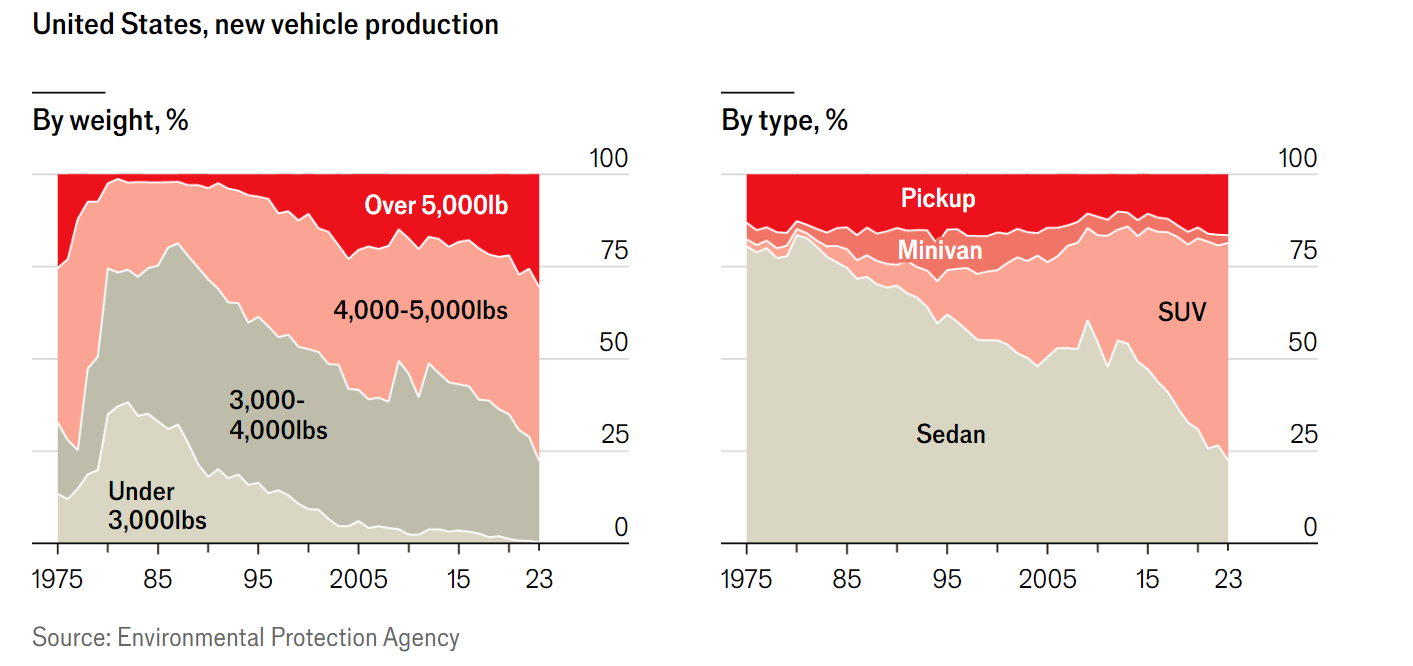
Regulators are ill-equipped to fix the problem. America’s tax system subsidises heavier vehicles by setting more lenient fuel-efficiency standards for light trucks (including SUVs) and allowing bosses who purchase heavy-duty vehicles for business purposes to deduct part of the cost from their taxable income. The National Highway Traffic Safety Administration (NHTSA), America’s top auto-safety agency only takes account of the safety of the occupants of the vehicle in question, not that of other drivers.
The shift towards electric
power is likely to increase their weight further, as battery-powered
vehicles tend to be heavier than their internal-combustion equivalents. (Note:
as they are virtually friction free they can travel at very high speeds unless
speed controls are built into their computer systems. My son has seen them on the
Edmonton-Calgary highway traveling at super speeds)
In 1975, in response to the 1973 oil crisis, the federal government
imposed fuel-economy standards on carmakers. To ease the burden on small
businesses that relied on big vehicles, the government exempted “light trucks”,
any vehicle that could be used off road and weighed less than 8,500lb (3855kg).
That meant SUVs—typically among the biggest and least-efficient cars—were
swept into the category and avoided the new fuel standards.
Because making light trucks held to lower environmental
standards was more profitable, automakers marketed big models, including SUVs,
enthusiastically. They portrayed them as quintessentially American, embodying
freedom, strength and adventurousness. By 2002 light trucks, including
SUVs, made up a bigger share of light-duty vehicle sales than cars. By the
1990s gasoline had become cheaper in America than in other rich countries—so
the cost of running a big car did not deter buyers. Such models are convenient
for suburban living, and consumers see them as safe.
And EVs are developing the same weight
problem as conventional cars. The EPA does not
regulate EVs’ indirect emissions, even though heavier models require more
electricity to charge, and need bigger batteries, which contain more of the
scarce metals used to make those batteries. In 2022 60% of electric-vehicle
sales in America were SUVs.
Conclusion
Nothing is likely to change in the near or medium term, though
the EPA is tightening the definition of light trucks. Running on a platform of
higher gas prices, slower speeds and smaller vehicles is a recipe for political
suicide. Canada’s Carbon Tax is about as popular as a skunk at a picnic.
Sunday, September 1, 2024
Back in the Saddle Again
September 1st and time to start blogging again. Summer has come and gone. My intentions are to blog weekly or is it weakly? Anyway we all know which road is paved with good intentions.
Wednesday, March 27, 2024
The Spy Who Came In With a Cold
Once more for old time's sake. Hey, I got a grandson out of that sort of thing. I wrote this for Debra at She who Seeks https://shewhoseeks.blogspot.com/. I used one of her sketches and promised to give her credit. She does some terrific black and white sketches.
The Spy Who Came In With a Cold
As I have noted before, all my troubles as a PI concern
dames. They want someone killed, someone wants to kill them, or they want to
kill me. If you saw me sitting in my office, nursing a glass of Johnny Walker
Red Label, you would realize that I had fallen on hard times. The sign on my door
may say Rick O’Shea, PI, but today PI stands for Poor Idiot.
A knock on the door perked me up. Maybe someone needed my services after all. I reached in the drawer for my gat in case it was someone who didn’t need my services. A brunette in a trench coat, dripping wet from the rain, entered carefully, looking left and right. The right hand in her pocket told me she was carrying, too.
 |
| Woman in a trench coat by Debra from She who Seeks |
“You hab to helb me”, she gasped. “Deethith and RDMB are abter
me. I dow doo mudch for dem to let me libe”.
“OK, lady, calm down, and here, use this. And stay away from
me”, I handed her some nasal decongestant spray. I keep it in the same drawer
as my gun. Emergencies, you know. Then I poured her a drink, “This will warm you up. Now
when you can breathe, tell me your story and we’ll make a plan”.
She collapsed into a chair, used the nasal spray with her
left hand and picked up the drink the same way, keeping her right hand in her
pocket. In a few minutes she breathed easier but never relaxed. She was scared.
“Never mind who I work for”, she said, finally, when she could breath. “I
accidentally learned of a huge cover up by CSIS and the RCMP of a major
political scandal. Heads will roll when it gets out unless they can roll mine
first. It is all on this flash drive”. And she pulled her right hand out of her
pocket and handed me the flash drive she had been holding onto for dear life. No gun.
“Oh, good”, I thought, “now they will want to kill me too”.
“Can you get this to The Globe and Mail? It must not get to
The National Post, or they will bury it deep. I can’t send it from my phone as
they are monitoring it for my location.”
Being a sucker for a good deed, I agreed, and took the flash
drive. “Now what do I do with you?”
“Get me out of the country,” she said. I can pay cash for
the ticket, but I need fake ID that will get me through airport security.” Like
I have that in my desk drawer. “That won’t be cheap. Have you enough cash for
that?”, I mentally calculated an exorbitant sum and added 20% finders fee for
myself. “I know people who know people”.
She pulled out a wad of USD that would choke a goat. I don’t
want to know. Her nose was running, I handed her a box of tissues whereupon she
did a good imitation of a barge asking the drawbridge to be raised.
I called Pete “the Fence” Picket. “I need
a set of ID for a mid-thirties brunette female, that will clear airport
security leaving Canada. Where she is going and who she is when she gets there
is not my business. Money is no object, I’ll meet you at the café across the
street from the bus stop at 12th and Crocus. Oh, and bring me two
burners”.
“Pete says it will be Five Grand USD in hundreds. Give it to
me and I’ll meet him to pick it up. It will take an hour. You have to trust me,
you have no choice”.
An hour later I was back with the ID and two burner phones
in my pocket, (along with $1000 USD “finders fee”). I gave her one of the burners.
“Dump your phone in the sewer grate outside the entrance door.”

I
hooked the flash drive to the burner and downloaded the files. I did NOT read
them. Found a number for the paper and fired them off. Ran the flash and the
burner through my industrial strength shredder and poured the pieces down the sewer grate. Not
foolproof but the best I could do.
Then I went out and bought a bottle of 18-year-old Laphroaig
but kept the Red Label in case hard times come again.
Sunday, March 24, 2024
Dear Friends and Followers, it isn't fun anymore
I have been blogging for 20 years. It has been enjoyable as I have met some good friends through my blog, I have learned a great deal is doing the background work for many of them. But I am tired. Ukraine wears me out. Palestine really wore me out.
I am reminded of the man going on a honeymoon cruise who stopped to buy seasick pills and condoms. The druggest said, "If it makes you sick, why do you do it?"
I will keep my blog in case I get the urge again. And will drop in on yours from time to time too.
Many thank for your friendship over the years
Monday, March 11, 2024
The Six-Day War of June 1967
In the Six-Day War of June 1967, Israel expanded and occupied the rest of the Arab territory of Mandated Palestine, including Jerusalem. It also took control of and occupied the Golan Heights of neighbouring Syria and the Sinai of Egypt. The 1967 war brought the second great Palestinian exodus. Half-a-million Palestinian people were uprooted and fled, half of them refugees for the second time.
The preemptive war began with an Israeli air assault in
Egypt and Syria. An Israeli ground offensive was also launched in the Sinai
Peninsula, the Golan Heights, the Gaza Strip, and the West Bank. These
territories were all captured by Israel, though the Sinai Peninsula was later
returned to Egypt. Golan Heights and West Bank gave Israel control over
precious water resources.
 |
| Source Israel Committee Against Housing Demonstrations https://icahd.org/ |
The war was sold as necessary because Israel faced an existential threat from Egypt and Syria. 15,000 Arab soldiers were killed and only 700 Israelis. Miko Peled examined the minutes of the meeting of Israeli generals, of which his father was one. He learned that the Egyptian army was at least a year and a half away from becoming a fighting force and that the Syrian army was even farther behind. The Six-Day War was one of taking advantage of Arab weakness and of territorial expansion within Palestine
Miko Peled, is an author, writer, speaker, and human rights
activist living in the United States. He was born in Jerusalem in 1961. His grandfather, Dr. Avraham Katsnelson
was a Zionist leader and signer on the Israeli Declaration of Independence. His
father, Matti Peled was a young officer in the war of 1948 and a general in the
Six-Day War. General Peled then turned peacemaker, urging a fair settlement
with the Palestinians. Miko’s unlikely opinions reflect his father’s legacy.
If you go to YouTube you can find several presentatins by Miko Peled https://youtu.be/jI2K5ZnOHUg?si=khOA1fvVxpoGb-zF. Also by Ilan Pappe https://youtu.be/qxQNk81ELbI?si=cz1G5wuiFkSqzduF
Prior to the 1960s Palestinian history was fairly easy to follow. The players were primarily Zionists, Palestinians, British and other Arab states. In the 1960s it gets more complicated. America becomes involved in a major way as does the UN. There are many oganizations and leaders appearing and many actions, reactions and negotiations taking place. I am still sorting these out as best I can.
I have enough energy for one major physical activity and one major mental activity per day, so I am often behind in reading other blogs or writing my own. Some days I feel like there is something wearing me out from the inside. So far the doctors have found nothing. They even examined my head. (straight line for some wit to capitalize on). They are still looking. Once I get some of that fixed, I am going to go for new knees.
Subscribe to:
Posts (Atom)